Rensselaer Adventures

This blog reports events and interesting tidbits from Rensselaer, Indiana and the surrounding area.

Friday, December 14, 2012

My Chrismas letter part 2

I mentioned yesterday that I was featuring home improvements in my annual Christmas letter, and wrote about the rewiring of my old house. The other big home improvement project of the year was ripping out carpet and refinishing floors. In April I had a post about refinishing the downstairs floor. That went so well that we decided to work on the upstairs floors.

A motivation to get going was bulk pick-up in May. What do you do with old carpet? It does not fit nicely into the weekly trash pick ups. So with a May deadline, we ripped out the upstairs carpets and they joined the downstairs carpet on the curb. No scavengers picked any of it up.
 The upstairs carpets were not installed like the downstairs carpet, which had used tacking strips along the edges to hold down the carpet. My guess is that the downstairs carpet was professionally installed. The upstairs carpet was glued down, and my guess is that it was not professionally installed. All that gray stuff you see on the floor is the glue that was left after we ripped out the carpet.
 (They missed a little bit--in this room there was one tiny strip in the middle of the floor that did not have glue.)

I tried my best to scrape up the glue, and I found that hand sanding it took some of it off. But there was still plenty left when we rented the floor sander. What we found to our dismay was that the glue did not sand up nicely. Rather the heat generated by the sander partially liquified the glue and it stuck like bubble gum on the sanding pads. The picture below shows the same room as above either before we started sanding or early in the sanding process.
 Though the area of flooring that we were refinishing upstairs was not greatly larger than what we did downstairs, we had to rent the sander twice. We did two rooms on one day, and then several weeks later did the other room and a hallway. We never got to the point where there was no glue gumming up the sanding pads, and I think we spent more on pads than we did to rent to sander.

Eventually the floor got to the state where we thought it was good enough and we were too tired to continue. Staining it was pretty easy, and so was applying a couple of coats of polyurethane.
Below is the finished product before we moved the furniture back. This floor is in the part of the house that seems to have been added a few years after the other part and the floors boards fit tighter. It was much harder to sand, possibly because the glue could not escape into the cracks.
It is great to have finished the project. I wonder how much of it we would have done if we had started in the room above, which was by far the hardest room to do, instead of ending there.

One other thing in my Christmas letter this year is a brief note on how much fun I had designing maze books that hardly anyone buys. Creating a book is still difficult, but getting it published is now very easy.

Thursday, December 13, 2012

My Christmas letter part 1

This is the time of the year to send and receive Christmas cards and letters. Over twenty years ago I began to send Christmas letters, partly to let friends and relatives know what we were doing and partly to keep a record of what happened during the year.

2012 did not have any big events (births, deaths, and weddings) for us. It was pretty quiet, so I decided to write about the home improvements that we made during the year. Actually, the big one, rewiring almost all the house, began in 2011.

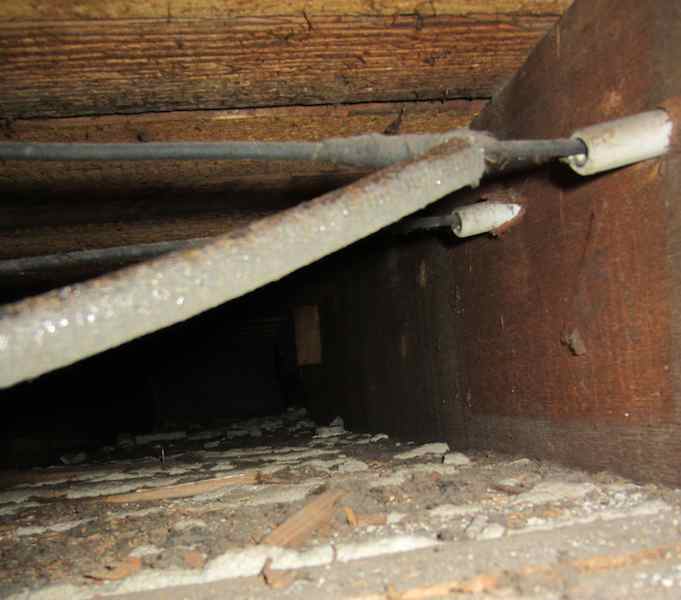
I live in a house that is a century old, and most of the wiring seems to have been installed when the house was built. Here is a picture of some wiring that is in the ceiling. It what is called knob and tube wiring. The two wires needed to make a circuit are kept completely separate. When they run through studs, as these wires are doing, they run through ceramic tubes, hence the tube part of the name.
 Rewiring requires new wires be installed, and sometimes that can be done by threading the wires through the  hollow spaces in walls using long fiberglass rods. However, sometimes it is necessary to cut holes in the plaster to get access. The picture above was taken using one such hole. The picture below shows a big one that was needed to connect a wall switch with an overhead light.
 Our rewiring was done by Valade Electric. Alan Valade was able to use time between other jobs to work on my house, so the process took many weeks, but he did an excellent job. The hole in the ceiling was patched after all the electrical work was done by Walter's Plastering & Drywall. Instead of trying to replace the old wooden lath, he put up a metal mesh that holds the plaster much better. The repaired sections are superior to the original work.
 The wiring in the second floor mostly came down from the attic, and Mr Valade did not want to work with the fiberglass and other insulation that was there. Midwest Contractor Services, a local company, took out the old insulation.
 It was rather colorful. I put it in about 30 years ago. I do not remember why it came in two colors.
 With the insulation gone, the old wiring was easy to see. Below you can see both knobs and tubes.
 I came to respect the old ways of doing things. This wiring lasted a century. How many other things last a century? Will the new ways of wiring last as long? What will happen to the plastics used in modern wiring over the next hundred years? Some of the insulation on the old wiring deteriorated, but because the wires were never in contact and because they were guided by the ceramic knobs and tubes, they still functioned even if the wire insulation had problems.

Below you can see what the new wiring looked like. Now we have three-pronged outlets and we do not need to keep trying to find adapters when we have three-pronged plugs. Plus we have more outlets--the people a century ago did not foresee how many things would run on electricity.
 When all the wiring was finished, Midwest Contractors came back and blew in insulation. I hope I never have a reason to go up there, because it will not be easy to get around.

Wednesday, December 12, 2012

UFO

I took the picture below a few weeks ago. What was the source of the bright lights in the sky?


Tuesday, December 11, 2012

New city street

The city now considers a stretch of Scott Street north of Merritt part of the city street network. This bit of the street is new--it was not there a few months ago, although broken-up asphalt has been dumped there for at least a year. I extends almost to the School House ditch. There are no houses along it yet, but unless the developer planned some houses, it would not have made sense to put it in.
The street is only half paved. The west side is asphalt, but the east side is stone. The road was built by a private developer to city specifications.

The Rensselaer Republican reported that the reason that the city added this bit of street to the city inventory is that it it increases the amount of money that the city gets from the state. Rensselaer has about 35 miles of city streets, not including whatever is in the annexation to Interstate 65, and each additional one tenth of a mile increases state funding.

I wonder how they compute how long the city streets are. What do they do so that they do not double count the intersections?

Sunday, December 9, 2012

New furnaces

This fall St. Augustine needed to replace its furnace. It did so with an array of five small furnaces installed by DeYoung Plumbing and Heating. One of the advantages of that arrangement is that each of the furnaces heats a particular section of the building so it is easier to heat only one part of the building. The new furnaces do not send the exhaust up the chimney, but through the wall. If I understand the technology correctly, the outgoing gasses heat the incoming air, improving efficiency. If you hold your hand in the exhaust flow, it is warm but not hot.
The picture shows all five of the new exhaust vents, though two are mostly obscured by the bush. It also shows a large metal grate that may or may not still be used for air flow, and a coal chute door that most definitely is no longer used. It is a reminder that at one time most of the buildings in Rensselaer were heated with coal. Now none are except those at Saint Joseph's College. Can you even buy coal anymore?