Tuesday, August 2, 2011
National Night Out Rensselaer 2011
Tuesday's National Night out was well attended. The pool probably has not had as many people in it this year. Temperatures over 96 degrees and a heat index of about 105 made it the place to be.
Another popular attraction of the night, once called Cookout with Cops, is the free hot dog supper. Betty really enjoyed her hotdog. And it was the first time she had ever had pop from a can.
The National Guard table had a display showing what meth does to teeth. They also had a chess game for anyone who wanted to play.
These kids wanted to see what all the levers and buttons on the firetruck did.
This year the helicopter arrived. Last year it did not.
Not everyone was happy with the helicopter. It seems to have interrupted someone's soccer practice.
The fire department and ambulance service did a crash rescue re-enactment. They managed to do it despite a fire call that took away some of the firemen and the firetruck shown a couple pictures above.
A water wars game was immensely popular with the kids. You got a bunch of water balloons and launched them at another kid in a similar booth. It was fun to get wet and fun to get the other person wet.
Along with the two booths was a contraption for filling water balloons.
I hope they bring it back next year.
Addendum--I talked to readers of this blog who found the post on batman useful. They have a larger colony of bats than I had.
Another popular attraction of the night, once called Cookout with Cops, is the free hot dog supper. Betty really enjoyed her hotdog. And it was the first time she had ever had pop from a can.
The National Guard table had a display showing what meth does to teeth. They also had a chess game for anyone who wanted to play.
These kids wanted to see what all the levers and buttons on the firetruck did.
This year the helicopter arrived. Last year it did not.
Not everyone was happy with the helicopter. It seems to have interrupted someone's soccer practice.
The fire department and ambulance service did a crash rescue re-enactment. They managed to do it despite a fire call that took away some of the firemen and the firetruck shown a couple pictures above.
A water wars game was immensely popular with the kids. You got a bunch of water balloons and launched them at another kid in a similar booth. It was fun to get wet and fun to get the other person wet.
Along with the two booths was a contraption for filling water balloons.
I hope they bring it back next year.
Addendum--I talked to readers of this blog who found the post on batman useful. They have a larger colony of bats than I had.
Monday, August 1, 2011
Wednesdays in the wild
Last Wednesday I attended the Wednesdays in the Wild program that was held at Fisher Oak Savanna. I am not sure who sponsors the Wednesdays in the Wild programs, but they are usually in the Lafayette area. About eight people showed up in addition to Brad, a NICHES stewardship manager. We walked a trail that I had not previously been on, one that goes out to an area of the preserve that was purchased only a few years ago.
The Fisher Oak Savanna is a great place for people who like native plants. If you do not care for native plants, there is not much there for you. I enjoyed the chance to have someone who knows a lot more than I do about plants answer questions.
There were several beautiful examples of cardinal flowers not too far from the parking lot.
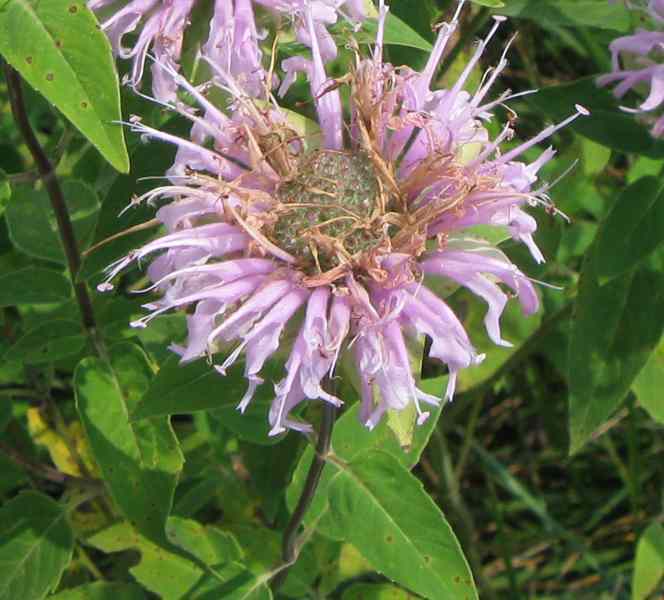
There was a lot of wild bergamot (Monarda fistulosa) blooming. This plant looks like a purple daisy with sloppy petals.
A closer look shows that what appear to be petals are actually the flowers. It is in the mint family. It is apparently quite easy to grow and often appears in flower gardens.
Out in the prairie section there were some blazing stars blooming. They stood out.
I would have never noticed this milkweed if it had not been pointed out. It is a blunt-leaf milkweed, or Asclepias amplexicaulis. Too bad it did not have flowers.
In the woods were a number of flowering plants that were new to me. Below is some kind of St. Johns wort.
This prairie flower that we found in the woods has a funny name: Monkey flower. Its Latin name is Mimulus ringens.
The flower below we also found in the woods, though its name is Meadow Beauty (Rhexia virginica).
On the way back we saw this flower, which looks a lot like a boneset. It is one of the Joe Pye weeds. (There are three different species and I do not know which of the three this one is.) I have been looking for this flower ever since I helped transplant seedlings of it for Nature Conservancy.
Here is a closer look.
In the back of the property was a yellow fringed orchid (Platanthera ciliaris). It is more common in the southeast than in our area.
The plant I was most surprised to see was a little patch of hemp or ditchweed (Cannabis sativa). I know that it grows in abundance in our area because it was grown for fiber production during World War II and has become invasive, but in all the years of living in Rensselaer, and that includes a number of years in which I jogged most of the roads within four or five miles of town, I had never seen it in the wild. Fifteen or twenty years ago there used to be frequent articles in the paper this time of the year about arrests of people harvesting it, but I have not seen any mention of that that lately.
I am told that the wild plants that grow here have little of the ingredients that make other varieties of this species a popular illegal drug.
One last thing I noticed was that ruins of the old potato field across the road, which was once an Obermyer farm, are more ruined than they were a couple years ago. This building, in particular, was standing a couple years ago.
I see from their newsletter that NICHES is in the process of acquiring another Jasper County Property, a ten-acre plot known as the Ranch half a mile south of the Jasper-Pulaski Fish and Wildlife Area. They describe it as a "black oak sand ridge and buttonbush slough."
The Fisher Oak Savanna is a great place for people who like native plants. If you do not care for native plants, there is not much there for you. I enjoyed the chance to have someone who knows a lot more than I do about plants answer questions.
There were several beautiful examples of cardinal flowers not too far from the parking lot.
There was a lot of wild bergamot (Monarda fistulosa) blooming. This plant looks like a purple daisy with sloppy petals.
A closer look shows that what appear to be petals are actually the flowers. It is in the mint family. It is apparently quite easy to grow and often appears in flower gardens.
Out in the prairie section there were some blazing stars blooming. They stood out.
I would have never noticed this milkweed if it had not been pointed out. It is a blunt-leaf milkweed, or Asclepias amplexicaulis. Too bad it did not have flowers.
In the woods were a number of flowering plants that were new to me. Below is some kind of St. Johns wort.
This prairie flower that we found in the woods has a funny name: Monkey flower. Its Latin name is Mimulus ringens.
The flower below we also found in the woods, though its name is Meadow Beauty (Rhexia virginica).
On the way back we saw this flower, which looks a lot like a boneset. It is one of the Joe Pye weeds. (There are three different species and I do not know which of the three this one is.) I have been looking for this flower ever since I helped transplant seedlings of it for Nature Conservancy.
Here is a closer look.
In the back of the property was a yellow fringed orchid (Platanthera ciliaris). It is more common in the southeast than in our area.
The plant I was most surprised to see was a little patch of hemp or ditchweed (Cannabis sativa). I know that it grows in abundance in our area because it was grown for fiber production during World War II and has become invasive, but in all the years of living in Rensselaer, and that includes a number of years in which I jogged most of the roads within four or five miles of town, I had never seen it in the wild. Fifteen or twenty years ago there used to be frequent articles in the paper this time of the year about arrests of people harvesting it, but I have not seen any mention of that that lately.
I am told that the wild plants that grow here have little of the ingredients that make other varieties of this species a popular illegal drug.
One last thing I noticed was that ruins of the old potato field across the road, which was once an Obermyer farm, are more ruined than they were a couple years ago. This building, in particular, was standing a couple years ago.
I see from their newsletter that NICHES is in the process of acquiring another Jasper County Property, a ten-acre plot known as the Ranch half a mile south of the Jasper-Pulaski Fish and Wildlife Area. They describe it as a "black oak sand ridge and buttonbush slough."
Saturday, July 30, 2011
Almost finished?
This morning (Saturday) the men from the R&T Fencing of Akron, Indiana were working on finishing the railing on the Talbert Bridge.
Around noontime they seemed to have pretty much finished the railing on the bridge, and were working on the rails along the concrete ramps. For that they had to drill some holes and fill them with concrete to anchor the posts, so it may be a day or two before the bridge will be open.
I had hoped that the bridge would be finished before the swimming pool opened, but it looks like it will at least make it before the pool closes. I think I heard that the last weekday it will be open is August 17.
Around noontime they seemed to have pretty much finished the railing on the bridge, and were working on the rails along the concrete ramps. For that they had to drill some holes and fill them with concrete to anchor the posts, so it may be a day or two before the bridge will be open.
I had hoped that the bridge would be finished before the swimming pool opened, but it looks like it will at least make it before the pool closes. I think I heard that the last weekday it will be open is August 17.
Last night
Tonight will be the last performance of the Carnegie Players' "Red, Hot, and Cole," a play featuring the music of Cole Porter (born in Peru, Indiana) and set in an overview of his life.
I like the costumes and set. The musical accompaniment was limited to piano, percussion, and guitar, but was well done. The play itself was largely a vehicle to showcase the music, and was not all that interesting. The problem with community and school theaters doing musicals with many singing roles is that usually the talent pool is not deep enough to bring it off given that we are so used to professional performances from television and the movies. I thought the Carnegie Players bit off a bit more than they could chew. But check it out for yourself and see what you think.
Friday, July 29, 2011
Adventures of a misconnect
Before we left Galesburg I asked the coach attendant how often they bussed passengers to Indianapolis. She said that they had been doing it every night for about the past month because the flooding had messed up the train schedules so badly. (Another tidbit from the train personnel--if the temperatures get up to 100 degrees, the trains slow down to twenty miles per hour--there is concern about the integrity of the track welds because of the expansion of the rails.)
The trip from Galesburg to Chicago was uneventful. There were no further delays, and it was now clear that we would not make train to Rensselaer. When we finally stopped at Union Station in Chicago, we were the first to find the passenger services office. It helped that we were nearest the exit on the car nearest the station. We walked in and announced that the Zephyr had arrived. Within a few minutes, the line of other Zephyr passengers was out the door and fifty feet long.
This may have been novel territory for us and the other passengers who had missed connections, but it was routine for passenger services. However, our Amtrak representative got very flustered when a heavy-set young man barged to the front of the line and demanded satisfaction. He apparently did not realize that everyone else in the line was in exactly the same situation as he was in. A manager soon arrived to calm him down.
The routine of the people in passenger services was to see if there was another train or bus that could get the person to his or her destination. Since there is no Greyhound service to Rensselaer and the train runs only once a day, that was not an option. Instead Amtrak would pay for a hotel room for us and we would take the train the next day. We had assumed that the hotel might be in the downtown, and that might allow us to visit some relatives the next day. That changed when we were told that the hotel that we would be staying in was in Homewood, Illinois. Homewood is south of Chicago, along the Tri-State, near the huge limestone quarry that the Tri-State goes over.
We were given a piece of paper for the hotel and a voucher which we took to the ticket agent who was across the way in one of the spots on the wonderful Art Deco ticket counter. She tried to give us new train tickets but the system was not accepting her request. She did, however, give us $60 for meals. (Different people got different amounts--I do not know how the amount was determined.)
Then it was time to go upstairs and find the van that was to take us to the hotel. The van turned out to be a bus and it already had quite a few people in it, some of whom had been waiting for quite a while. To my right was a young man who was 17 or 18 years old, not yet out of high school, whose train from Michigan had been late. Ahead of me was a sadder story--some passengers who had been at the station in plenty of time, but who watched the departure menu keep displaying a "delayed" message, and missed their train because it was never announced. Over the next forty five minutes or hour the bus gradually filled up with Zephyr passengers.
Then it was off to the hotel. We arrived and the clerk knew exactly what do to do because this is a nightly occurrence for her. Every night there are misconnects, and every night they end up here. We filled out a short form with our names and addresses, gave the clerk the piece of paper that the lady at Amtrak had given us, and got our room key. Since she had the people in the line fill out the forms while they waited, the whole check-in took less than fifteen minutes.
The hotel was probably built when the Tri-State was built, and I am guessing that that was in the 1960s or at the latest the early 1970s. In its early years it must have been quite the place. However, it probably never attracted as much business as the developers hoped it would, and there seemed to have been few changes in the fifty years it had been there.
The intense heat of the previous week was still in evidence inside the hotel, and since hot air rises, our rooms on the fifth floor were hot. There was air conditioning, but it could not cope with the heat when everyone turned on their units. Our bathtub drained very slowly, and though the hotel had wi-fi, the signal was very weak, only one bar in our room, and my computer would not connect until the next morning. But at least it did finally connect.
The room did cool down enough to allow us to sleep, and the bed sure was a lot more comfortable than sleeping in a train seat. The next morning we got up for the free breakfast. Maybe they had more earlier, but all that was there when we got there were some muffins and glazed donuts that were melting.
The bus was scheduled to arrive at 11:00 to take us back to Union Station, but the driver had told everyone to be in the lobby by 10:30. Most were; we were going to spend a lot of time waiting one place or another. It was raining when we boarded the bus, and someone in the seat behind me discovered that there was some water leaking from a vent on the roof when we got underway. What else could go wrong?
When we got back to the station, most of us got in the ticket line because we had to exchange tickets. Our tickets were for the train the previous day and we needed tickets for today's train. The line was long and slow moving for at least an hour. One of our fellow misconnects commented that the Chicago station is the busiest in the Amtrak system and also the most disorganized. Maybe it is the most disorganized because it is the busiest, or maybe because it is Chicago.
A few of our fellow misconnects had to get on a 12:15 train, so they were treated separately and were soon on their way. Others of us had late afternoon trains to catch. We found the food court and checked out all the menus, finally ordering. There was no need to hurry. After we had eaten, we found another group of misconnects, a couple from Virginia with their two sons, and spent several hours talking to them. They were delightful people, and their fifth grader son was a lot of fun. He loved his skateboard and the military channel on television, and knew an amazing amount of military history for a person his age.
About an hour before our train was scheduled to leave, we went downstairs to the Amtrak waiting area. Amtrak boards seniors, those over 62, first, so we had only a short wait before we were let into another waiting area, and then after a few minutes there, we were sent to our train. It had a bunch of cars on it, but only the last two cars, coach cars that only had one level, were used. Each car held almost 70 passengers, which was ten to fifteen less than the cars on the California Zephyr. After all the passengers had boarded, it looked like all the seats were filled.
If you have ever taken the Amtrak from Chicago, the chances are good that you had some delays as your train waited for the traffic on the tracks ahead to clear. We had no delays, and as a result, we had an experience that was a first for our Amtrak adventures--we arrived at our first stop, Dyer, Indiana, ahead of schedule. In fact we were so far ahead of schedule that the conductor told the passengers that they could get out of the train and walk around for almost fifteen minutes. Several of the passengers spotted a Subway restaurant next to the station and ran over to get food. All of them made it back to the train with time to spare.
Dyer is like Rensselaer in that it has a small Amshack station, though it is slightly larger than ours. It also has nicer chairs, though they have had some vandalism.
I was happy to get back on the train and head home. One thing that struck me as we rode though Newton and Jasper county was how many trees were along the route as compared to what we saw in Illinois, Iowa, and Nebraska. I think of our area as mainly corn and soybean fields, but compared to what we saw in those other states, considerably more of our land is non-agricultural.
This trip re-enforced the conclusion that travel by train is not primarily for those who want to get to a destination with as little trouble as possible (though it may be for older people who do not want to drive). Travel by train is attractive when you want the trip to be part of the adventure.
It was interesting to see how various people reacted to the interruptions in their schedule. Some were very upset and a number were promising to send nasty letters to Amtrak. Others took it in stride and tried to make the best of the situation.
Perhaps the most interesting part of the extra day was the way that complete strangers met and talked and helped each other as if they were old friends. These people we enjoyed interacting with will drop out of our lives and we will never see or hear from them again. However, I sure did enjoy meeting some of them. (Maybe the day was life sped up--we get to know people who then move on and drop out of our life, but the process usually takes years. We saw the process compressed into a day.)
The trip from Galesburg to Chicago was uneventful. There were no further delays, and it was now clear that we would not make train to Rensselaer. When we finally stopped at Union Station in Chicago, we were the first to find the passenger services office. It helped that we were nearest the exit on the car nearest the station. We walked in and announced that the Zephyr had arrived. Within a few minutes, the line of other Zephyr passengers was out the door and fifty feet long.
This may have been novel territory for us and the other passengers who had missed connections, but it was routine for passenger services. However, our Amtrak representative got very flustered when a heavy-set young man barged to the front of the line and demanded satisfaction. He apparently did not realize that everyone else in the line was in exactly the same situation as he was in. A manager soon arrived to calm him down.
The routine of the people in passenger services was to see if there was another train or bus that could get the person to his or her destination. Since there is no Greyhound service to Rensselaer and the train runs only once a day, that was not an option. Instead Amtrak would pay for a hotel room for us and we would take the train the next day. We had assumed that the hotel might be in the downtown, and that might allow us to visit some relatives the next day. That changed when we were told that the hotel that we would be staying in was in Homewood, Illinois. Homewood is south of Chicago, along the Tri-State, near the huge limestone quarry that the Tri-State goes over.
We were given a piece of paper for the hotel and a voucher which we took to the ticket agent who was across the way in one of the spots on the wonderful Art Deco ticket counter. She tried to give us new train tickets but the system was not accepting her request. She did, however, give us $60 for meals. (Different people got different amounts--I do not know how the amount was determined.)
Then it was time to go upstairs and find the van that was to take us to the hotel. The van turned out to be a bus and it already had quite a few people in it, some of whom had been waiting for quite a while. To my right was a young man who was 17 or 18 years old, not yet out of high school, whose train from Michigan had been late. Ahead of me was a sadder story--some passengers who had been at the station in plenty of time, but who watched the departure menu keep displaying a "delayed" message, and missed their train because it was never announced. Over the next forty five minutes or hour the bus gradually filled up with Zephyr passengers.
Then it was off to the hotel. We arrived and the clerk knew exactly what do to do because this is a nightly occurrence for her. Every night there are misconnects, and every night they end up here. We filled out a short form with our names and addresses, gave the clerk the piece of paper that the lady at Amtrak had given us, and got our room key. Since she had the people in the line fill out the forms while they waited, the whole check-in took less than fifteen minutes.
The hotel was probably built when the Tri-State was built, and I am guessing that that was in the 1960s or at the latest the early 1970s. In its early years it must have been quite the place. However, it probably never attracted as much business as the developers hoped it would, and there seemed to have been few changes in the fifty years it had been there.
The intense heat of the previous week was still in evidence inside the hotel, and since hot air rises, our rooms on the fifth floor were hot. There was air conditioning, but it could not cope with the heat when everyone turned on their units. Our bathtub drained very slowly, and though the hotel had wi-fi, the signal was very weak, only one bar in our room, and my computer would not connect until the next morning. But at least it did finally connect.
The room did cool down enough to allow us to sleep, and the bed sure was a lot more comfortable than sleeping in a train seat. The next morning we got up for the free breakfast. Maybe they had more earlier, but all that was there when we got there were some muffins and glazed donuts that were melting.
The bus was scheduled to arrive at 11:00 to take us back to Union Station, but the driver had told everyone to be in the lobby by 10:30. Most were; we were going to spend a lot of time waiting one place or another. It was raining when we boarded the bus, and someone in the seat behind me discovered that there was some water leaking from a vent on the roof when we got underway. What else could go wrong?
When we got back to the station, most of us got in the ticket line because we had to exchange tickets. Our tickets were for the train the previous day and we needed tickets for today's train. The line was long and slow moving for at least an hour. One of our fellow misconnects commented that the Chicago station is the busiest in the Amtrak system and also the most disorganized. Maybe it is the most disorganized because it is the busiest, or maybe because it is Chicago.
A few of our fellow misconnects had to get on a 12:15 train, so they were treated separately and were soon on their way. Others of us had late afternoon trains to catch. We found the food court and checked out all the menus, finally ordering. There was no need to hurry. After we had eaten, we found another group of misconnects, a couple from Virginia with their two sons, and spent several hours talking to them. They were delightful people, and their fifth grader son was a lot of fun. He loved his skateboard and the military channel on television, and knew an amazing amount of military history for a person his age.
About an hour before our train was scheduled to leave, we went downstairs to the Amtrak waiting area. Amtrak boards seniors, those over 62, first, so we had only a short wait before we were let into another waiting area, and then after a few minutes there, we were sent to our train. It had a bunch of cars on it, but only the last two cars, coach cars that only had one level, were used. Each car held almost 70 passengers, which was ten to fifteen less than the cars on the California Zephyr. After all the passengers had boarded, it looked like all the seats were filled.
If you have ever taken the Amtrak from Chicago, the chances are good that you had some delays as your train waited for the traffic on the tracks ahead to clear. We had no delays, and as a result, we had an experience that was a first for our Amtrak adventures--we arrived at our first stop, Dyer, Indiana, ahead of schedule. In fact we were so far ahead of schedule that the conductor told the passengers that they could get out of the train and walk around for almost fifteen minutes. Several of the passengers spotted a Subway restaurant next to the station and ran over to get food. All of them made it back to the train with time to spare.
Dyer is like Rensselaer in that it has a small Amshack station, though it is slightly larger than ours. It also has nicer chairs, though they have had some vandalism.
I was happy to get back on the train and head home. One thing that struck me as we rode though Newton and Jasper county was how many trees were along the route as compared to what we saw in Illinois, Iowa, and Nebraska. I think of our area as mainly corn and soybean fields, but compared to what we saw in those other states, considerably more of our land is non-agricultural.
This trip re-enforced the conclusion that travel by train is not primarily for those who want to get to a destination with as little trouble as possible (though it may be for older people who do not want to drive). Travel by train is attractive when you want the trip to be part of the adventure.
It was interesting to see how various people reacted to the interruptions in their schedule. Some were very upset and a number were promising to send nasty letters to Amtrak. Others took it in stride and tried to make the best of the situation.
Perhaps the most interesting part of the extra day was the way that complete strangers met and talked and helped each other as if they were old friends. These people we enjoyed interacting with will drop out of our lives and we will never see or hear from them again. However, I sure did enjoy meeting some of them. (Maybe the day was life sped up--we get to know people who then move on and drop out of our life, but the process usually takes years. We saw the process compressed into a day.)
Subscribe to:
Posts (Atom)